How Did You Learn To Express Anger?
Curiosity in Anger Management Counselling.
In a world where we are praised for keeping it together, where healthy anger isn't learned, the consequence is often suppression until we blow up.
Let’s look at anger, or emotions in general from a young child’s perspective, they can move through anger with so much ease. It arrives, they identify it, express it, and then they move on. This continues until someone can't handle their anger and tells them it's not okay or that they don't like it. This question is often asked in therapy: "How did you learn about anger? Who and how did you see manage their anger?"
My follow-up question is always, "Who met you and stayed with you when you were angry?"
These questions help me understand how you may have learned to suppress your anger or perhaps understand some beliefs around expressing anger. Exploring this also helps us understand who you could trust when you were angry, who heard you, and who was curious enough to ask what was happening for you and how they could help you.
A combination of modelled behaviour, avoidance, and constantly assessing whether anger was okay or not okay creates a physiological holding pattern that becomes reinforced over time. Often, when clients come to counselling for anger management, it is important to acknowledge how hard and how long they've been containing their anger because they haven't had the means to express it in a healthy manner.
Fearful of expressing anger because there might be a loss of connection with loved ones, you may feel out of control and behave in ways that you or others aren't okay with. You might also experience bigger repercussions, such as losing your employment.
Anger is a self-protective emotion. If you can listen to it, it is often attempting to communicate something to you. It might be trying to show you where your boundaries have been violated, where there is fear of loss, or even where your values are in jeopardy.
The question, "What is this feeling trying to tell me?" is a worthy exploration.
Helping clients learn how to titrate, in small chunks, into the experience of anger is an important aspect of working with anger management. Otherwise, it becomes overwhelming, and they respond in exactly the same ways they have learned to over the years. We are looking to create new opportunities for clients to respond differently.
Therefore, mapping out the terrain of your belief system, physiology, and learned behaviours is an important component of learning how to manage anger more effectively, which in turn invites healthier ways of expressing it.
Upside Down Triangle Explanation
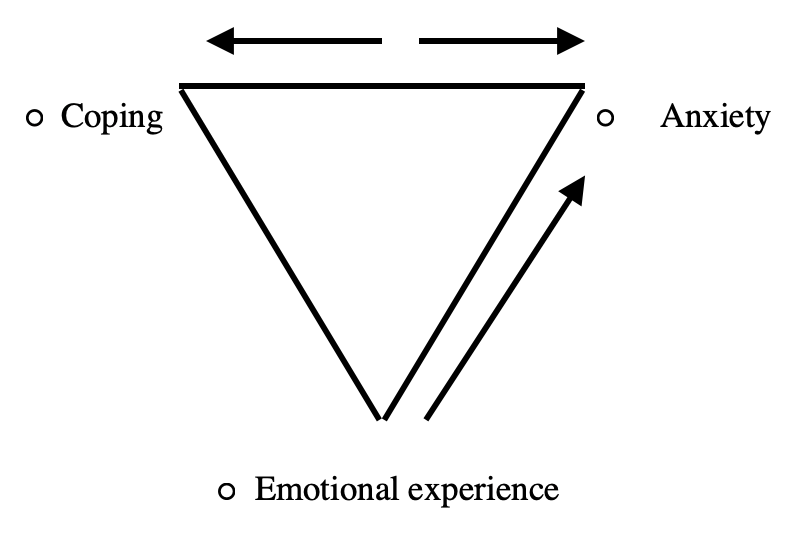
If it is hard to be with your emotional experience then you shoot up towards anxiety, when anxiety becomes too much to handle then you move over to coping. Often times attempting to manage the overwhelm looks like toggling back and forth between anxiety and coping.
Only when you go down to the point of the triangle where you can build tolerance to be with your emotional experience can you identify what you need based on the feelings you are having.
If you're noticing these patterns in yourself, anger management counselling can help you build a different relationship with this emotion. Reach out to book a session.

With care,
Kimberly Castle, MTC, RCS, CC-BRT, SEP®
Reclaiming presence, fostering resilience, and returning to our amazing biology that knows what to do when given time and space.
Kimberly Castle is a Somatic Experiencing Practitioner® and a registered counsellor with a private practice in beautiful Kelowna, BC. She focuses on Kelowna Counselling She and her team specialize in Somatic Therapy where sessions are gentle, non-invasive, and guided at your pace.